





Journal of Historic Buildings and Places 2024
The content of the Journal of Historic Buildings and Places tends to reflect its wide statutory remit, covering buildings of all ages and types. This issue includes an insightful review by Colin Thom, director of the Survey of London (see page 20 of this issue of Context) on the survey’s creation; its past activities within London County Council; its survival after the demise of the GLC; its present home at the Bartlett School of Architecture, University College London; and its future direction and activities, including how to bring its valuable work to a wider audience.
Considering its ubiquity, there should perhaps be a wide audience for the understanding of the contribution of early Victorian Tudor gothic to domestic architecture. This is the title of a tellingly illustrated article by Anthony Jennings, who discusses, over nearly 30 pages, the evolution from the medieval house to a domestic revival through to the present day. This often encountered but imperfectly understood architectural style provided long-lasting templates from the 1830s and 40s, with implications for the English house having influence elsewhere. The author also discusses the perfection of gothic and the influence of a range of pattern books that emerged between 1831 and 1836.
In this issue, Patrick Newberry, an authority on the architecture of Cornwall, discusses at length and illustrates the work of James Piers St Aubyn (1815-95). St Aubyn was deemed in his time to be a successful architect with nearly 400 buildings to his credit, but he was vilified in the 20th century for adopting a heavy-handed approach to restoration and the repair of historic churches.
Reflecting the wide remit of Historic Buildings and Places, the journal also contains an inquiry by Victoria Watson, co-convenor of the Design Practices Research Group at the University of Westminster, into the architectural identity of Herzog and de Meuron, with reference to Tate Modern, London, and the Museum of the Twentieth Century, Berlin, and the practice being notable for having no signature style.
This article originally appeared in the Institute of Historic Building Conservation’s (IHBC’s) Context 181, published in September 2024.
--Institute of Historic Building Conservation
Related articles on Designing Buildings Conservation.
IHBC NewsBlog
IHBC sponsors Gardens Trust event 23-4 Sept 2026
.jpeg)
'Learning from the Past, Shaping the Future’ takes place in Milton Keynes
Renovations to Frank Lloyd Wright's Fallingwater complete
.jpg)
World Heritage Preserved project opens house for tours again
Shakespeare Birthplace Trust places Hall's Croft on HAR Register
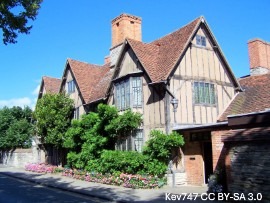
Stratford-upon-Avon home of Shakespeare's daughter is 'At Risk'
Lady Grange’s House repaired on St Kilda
.jpg)
National Trust for Scotland repairs stone cleit with link to famous island resident
Griff Rhys Jones on BBC Radio 4 Today programme
,_Green_Lane,_Derby.jpg)
The Victorian Society’s President unveiled its latest Top Ten Endangered Buildings 2026.
Need a MATE? Book your place now.

IHBC offers free webinars on applying for IHBC accreditation (Full & Associate).
UK Stained Glass Repository finds windows new homes
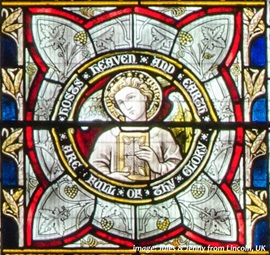
How are stained glass windows are rescued, stored and repurposed?
APPGEBE report sets high aims for quality
'Government must not sacrifice quality in drive to build 1.5m homes'
New measures protect Historic Shipwrecks from heritage crime

Underwater cultural heritage benefits from new HE guidance
How could the City of London skyline look in 6 years' time?

Visualisation shows approved planning applications as completed buildings
National Trust for Scotland calls for VAT cuts
Heritage neglect is encouraged by current policies
IHBC's 'Context' Issue 186 features Industrial Heritage
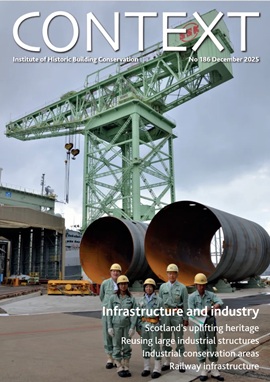
IHBC's members' journal reports on the challenges of conserving infrastructure
Book now for IHBC Annual School 2026

IHBC Annual School is taking place 18-20 June 2026 in Newcastle
RICHeS Research Infrastructure offers ‘Full Access Fund Call’

RICHeS offers a ‘Help’ webinar on 11 March
Latest IHBC Issue of Context features Roofing
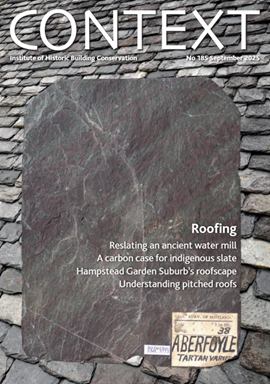
Articles range from slate to pitched roofs, and carbon impact to solar generation to roofscapes
Three reasons not to demolish Edinburgh’s Argyle House

Should 'Edinburgh's ugliest building' be saved?
IHBC’s 2025 Parliamentary Briefing...from Crafts in Crisis to Rubbish Retrofit
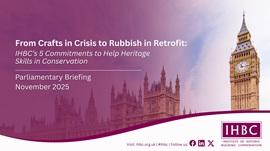
IHBC launches research-led ‘5 Commitments to Help Heritage Skills in Conservation’
How RDSAP 10.2 impacts EPC assessments in traditional buildings

Energy performance certificates (EPCs) tell us how energy efficient our buildings are, but the way these certificates are generated has changed.